
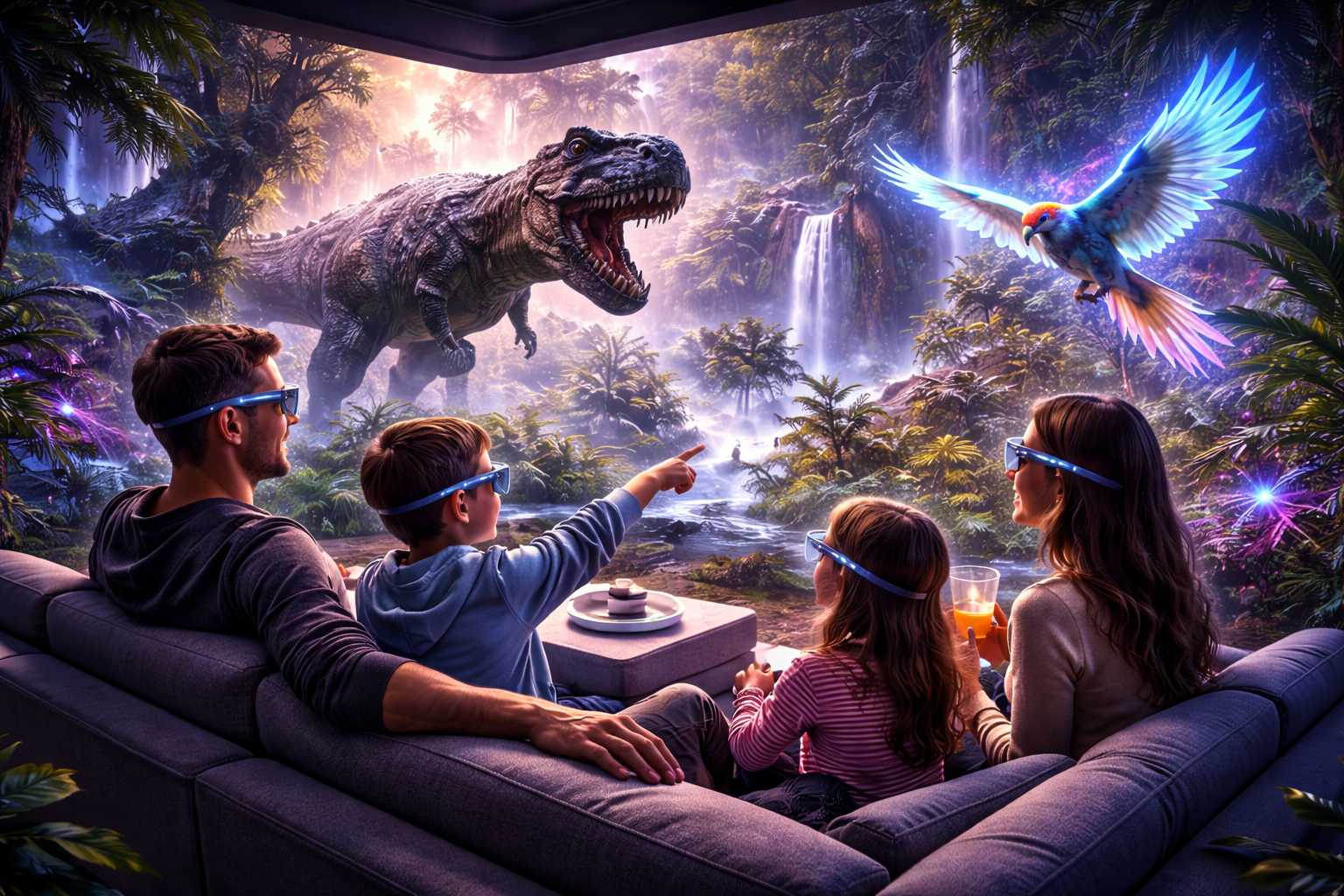
The way we consume stories is about to change forever. For decades, the “Home Entertainment” experience was defined by a glowing rectangle on a wall. But as we look toward 2026, the boundaries between the digital world and our physical reality are dissolving. The Future of Home Entertainment is no longer about watching a screen; it is about stepping inside the story.
In this “Top News” special report for TeaTV, we analyze the seven most disruptive shifts that will redefine your living room by 2026. From AI-generated personalized movies to spatial “living” cinemas, here is what you need to know to stay ahead of the curve.
Section 1: The Death of the “Screen” and the Birth of Spatial Cinema
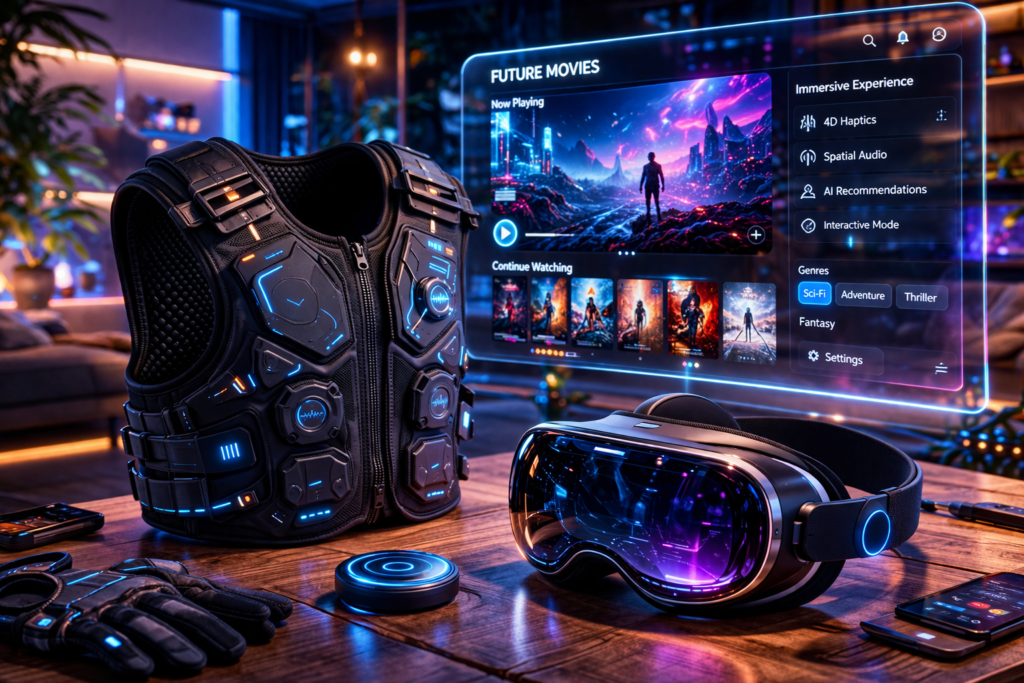
By 2026, the traditional 4K TV will start looking like a relic of the past. The Future of Home Entertainment is dominated by Spatial Computing. With the evolution of devices like the Apple Vision Pro 3 and the Meta Quest Pro 4, cinema is becoming “borderless.”
Instead of a 65-inch TV, imagine your entire living room transforming into the setting of the movie. If you are watching a sci-fi epic, your walls become the hull of a spaceship. If it’s a horror movie, the shadows in your actual room are used to hide the monsters. This level of immersion is the next “Top News” in global entertainment tech.
Check out our Trending News section for the latest on Spatial Computing devices
Section 2: 7 Future of Home Entertainment Trends for 2026
Trend #1: AI-Generated “Personalized” Storylines
Imagine watching a movie where you can change the ending by simply telling the AI. In 2026, “Generative Cinema” will allow viewers to interact with characters. If you don’t like a plot twist, the AI will re-render the scene in real-time to fit your preference. This is the ultimate Future of Home Entertainment hack for personalized satisfaction.
Trend #2: 16K Ultra-Immersion and Nano-LED Walls
For those who still prefer physical screens, 2026 will bring the rise of “Wall-to-Wall” Nano-LEDs. These aren’t just TVs; they are architectural elements. These screens provide 16K resolution, which is indistinguishable from real life, making the Future of Home Entertainment feel like a window into another world.
Trend #3: Haptic Feedback Vests and “Feel-O-Vision”
Why just see the explosion when you can feel it? Haptic technology is moving from gaming to mainstream cinema. By 2026, lightweight haptic vests will allow you to feel the raindrops, the rumble of an engine, or even a heartbeat during a tense scene. This sensory integration is a massive part of the Future of Home Entertainment.
Trend #4: The “Hyper-Aggregator” Streaming Era
The “Streaming Wars” will end with the rise of AI Hyper-Aggregators. No more switching between 10 different apps. In 2026, a single AI interface will curate every piece of content globally based on your mood, facial expressions, and past viewing habits.
Read about the evolution of streaming on Variety or The Verge
Trend #5: 3D Holographic “Social” Viewing
Long-distance movie nights are getting a major upgrade. In the Future of Home Entertainment, your friend who lives 5,000 miles away will appear as a high-fidelity 3D hologram sitting right next to you on your sofa. You can share popcorn and reactions as if you were in the same room.
Trend #6: Neural-Link Audio (Direct-to-Brain Sound)
Audio technology is moving beyond speakers. Advanced “Beamforming” and early-stage neural interfaces will allow sound to be “projected” directly to your auditory cortex. This means you can hear a cinematic masterpiece in full Dolby Atmos 360, while the person sitting next to you hears total silence.
Trend #7: Web3 and Decentralized Movie Ownership
The Future of Home Entertainment will also change how we buy movies. Using blockchain, fans will be able to “own” a piece of a film’s production. In 2026, you won’t just be a viewer; you will be a micro-shareholder in the next viral blockbuster, earning royalties as it trends globally.
Section 3: The Impact on Global Society and Mental Health
As the Future of Home Entertainment becomes more immersive, psychologists are raising “Top News” concerns about “Reality Blur.” When a movie feels as real as life, how do we disconnect?
However, the benefits are also immense. For the elderly or those with limited mobility, spatial cinema offers a way to “travel” the world and experience concerts or nature from the safety of their homes. This is a powerful shift in the quality of life for millions worldwide.
Visit our World News section to see how different countries are regulating AI Cinema
Section 4: Why This Matters for TeaTV Readers
At TeaTV, we have always been at the forefront of the streaming revolution. Understanding the Future of Home Entertainment is crucial for our community. Whether you are a casual viewer or a hardcore cinephile, the transition to 2026 will offer more choice, more immersion, and more control than ever before in human history.
Section 5: Monetization and AdSense Strategy for Entertainment Blogs
For creators and publishers, the Future of Home Entertainment niche is a goldmine.
-
High CPC: Advertisers from Apple, Sony, and Meta are constantly bidding for these keywords.
-
Evergreen Content: While “Top News” can fade, the technological shift toward 2026 is a long-term trend that will drive traffic for years.
-
Affiliate Potential: Reviewing VR headsets and high-end home theater gear provides a secondary revenue stream alongside Google AdSense.
Conclusion: Preparing for the 2026 Shift
The Future of Home Entertainment is bright, bold, and incredibly fast-moving. As we approach 2026, the way we tell and receive stories will be the “Top News” of the decade. Stay tuned to TeaTV as we continue to track these technological breakthroughs that are turning science fiction into our daily reality.