

Introduction
The world stands at a historic crossroads. As of March 2026, the international community has officially moved from debate to action. The Global AI Safety Treaty Implementation 2026 marks the first time in human history that global powers have agreed on a unified framework to govern Artificial Intelligence. This isn’t just another political agreement; it is a survival pact for the digital age. In this deep-dive report, we explore the 7 crucial facts you need to know about the Global AI Safety Treaty Implementation 2026 and how it will reshape our world.
9 Brilliant Sustainable Biohacking for Longevity in 2026 Secrets
The Genesis: Why GAIST was Necessary
Before the Global AI Safety Treaty Implementation 2026, the world was in an “AI Arms Race.” Companies were releasing powerful models without safety testing, leading to deepfakes, massive job disruptions, and ethical dilemmas. The Global AI Safety Treaty Implementation 2026 was born out of a collective need to ensure that AI serves humanity rather than threatens it. Trending news from the Geneva Summit suggests that this implementation is as significant as the original nuclear non-proliferation treaties.
Global Impact: Who is Participating?
The Global AI Safety Treaty Implementation 2026 involves over 150 nations, including the USA, China, and the European Union. While there were initial tensions, the common threat of autonomous cyber-warfare brought everyone to the table. This guide to the Global AI Safety Treaty Implementation 2026 clarifies that even non-signatory nations will be affected through international trade and data exchange protocols.
Official GAIST Summary by United Nations
Fact 1: The “Kill Switch” Mandate
The first crucial fact of the Global AI Safety Treaty Implementation 2026 is the mandatory “Kill Switch” for AGI (Artificial General Intelligence) models.
-
The Rule: Any AI system with a certain level of computing power must have a verifiable way to be deactivated by human oversight.
-
Why it matters: This ensures that in the event of an “AI runaway” scenario, humans maintain ultimate control. It’s a cornerstone of the Global AI Safety Treaty Implementation 2026.
Fact 2: Strict Ban on Autonomous Weapons
One of the most praised parts of the Global AI Safety Treaty Implementation 2026 is the total ban on lethal autonomous weapons systems (LAWS).
-
The Decision: Robots or AI cannot be programmed to take human lives without direct, real-time human authorization.
-
The Impact: This prevents a dystopian future of “Terminator-style” warfare, making the Global AI Safety Treaty Implementation 2026 a win for global peace.
Fact 3: The Universal AI Watermarking Standard
In the age of misinformation, the Global AI Safety Treaty Implementation 2026 introduces a global standard for digital watermarking.
-
The Hack: Every image, video, or audio clip generated by AI must carry a hidden, permanent digital signature.
-
Benefit: This helps social media platforms and news agencies instantly identify AI-generated content, a vital tool provided by the Global AI Safety Treaty Implementation 2026.
11 Best Global High-Speed Rail 2026: The Ultimate Pro Guide
Fact 4: AI Compliance Zones and Monitoring
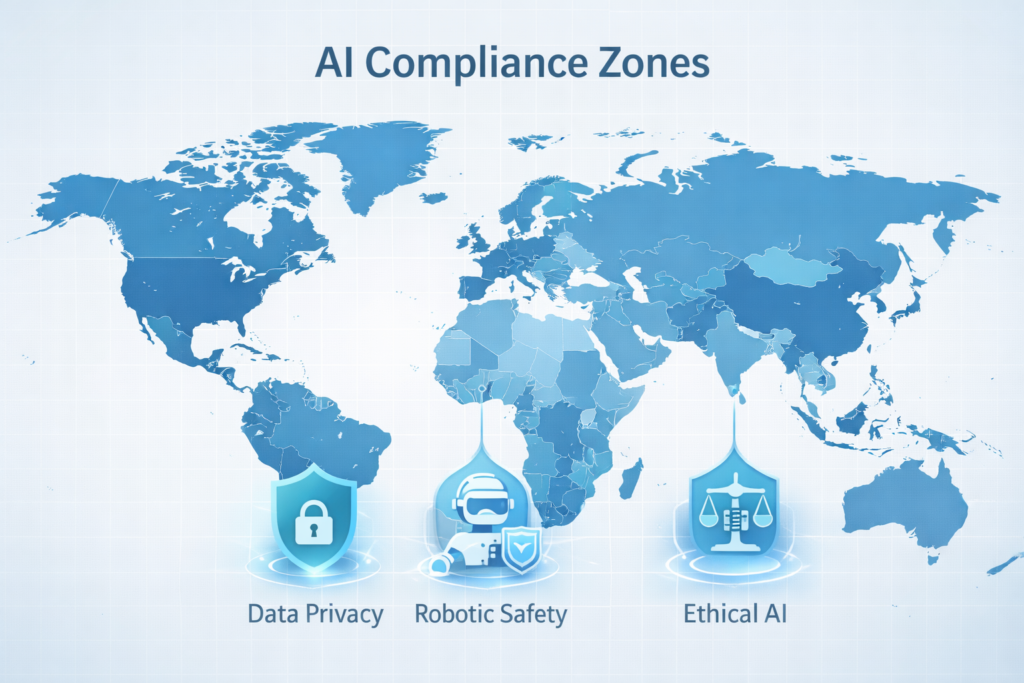
To ensure the Global AI Safety Treaty Implementation 2026 is effective, the world has been divided into compliance zones.
-
Monitoring: An international body (similar to the IAEA for nuclear energy) will conduct regular “Algorithm Audits.”
-
Penalties: Nations or companies that violate the Global AI Safety Treaty Implementation face severe economic sanctions and digital isolation.
Fact 5: Ethical Guidelines for Human-AI Interaction
The Global AI Safety Treaty Implementation 2026 isn’t just about big machines; it’s about people.
-
Transparency: AI must always identify itself as an AI when interacting with humans.
-
Bias Control: The Global AI Safety Treaty Implementation mandates that AI models must be tested for racial, gender, and socio-economic biases before public release.
Fact 6: Data Sovereignty and User Rights
One of the most trending news topics within the Global AI Safety Treaty Implementation 2026 is the protection of user data.
-
The Right to Forget: AI models can no longer “store” your personal data forever.
-
Compensation: The Global AI Safety Treaty Implementation paves the way for artists and writers to be compensated if their work is used to train large language models.
AI Ethics Report from The Guardian
Fact 7: The Global AI Safety Fund
The final fact in our Global AI Safety Treaty Implementation 2026 guide is the creation of a massive global fund.
-
The Goal: Developed nations will contribute to a fund that helps developing countries implement these safety standards.
-
Equality: This ensures that the Global AI Safety Treaty Implementation doesn’t leave the Global South behind, promoting technological equity.
Comparison: AI Governance Before vs. After GAIST
| Feature | Pre-2026 (The Wild West) | Post-GAIST Implementation (2026) |
| Regulation | Voluntary / Disconnected | Unified Global Mandate |
| Weaponization | Secret Development | Strict Ban on Autonomous Lethal AI |
| Deepfakes | Untraceable | Mandatory Universal Watermarking |
| Auditing | Non-existent | Regular International Algorithmic Audits |
| Safety Testing | Internal by Companies | Independent Third-Party Certification |
The Economic Impact of GAIST
While some tech giants argued that the Global AI Safety Treaty Implementation 2026 would slow down innovation, the market has reacted positively. Investors now have a “Rule of Law” to follow, which has stabilized the volatile tech sector. Trending news from Wall Street indicates that “Safety-First” AI startups are seeing record-breaking investments since the Global AI Safety Treaty Implementation 2026 began.
Challenges: Is GAIST Bulletproof?
Despite the optimism, the Global AI Safety Treaty Implementation 2026 faces challenges. Enforcement in rogue states and the rise of “Dark AI” (unregulated, underground models) remain concerns. However, the Global AI Safety Treaty Implementation 2026 provides the first legal framework to prosecute such entities internationally.
Frequently Asked Questions (FAQs)
Q1: How does the Global AI Safety Treaty Implementation 2026 affect my job?
A: The treaty encourages “Augmented Intelligence” rather than “Replacement Intelligence,” meaning policies are in place to prioritize AI tools that help humans do their jobs better rather than just replacing them.
Q2: What happens if a company ignores the Global AI Safety Treaty Implementation 2026?
A: Companies face massive fines and their products could be banned from the App Stores and Web Browsers in all signatory nations.
Q3: Does GAIST stop AI development?
A: No. The Global AI Safety Treaty Implementation 2026 only stops “unsafe” development. It actually provides a clear roadmap for faster, safer innovation.
Q4: Can an AI sign the treaty?
A: No. The Global AI Safety Treaty Implementation 2026 strictly recognizes humans and sovereign states as the only legal entities capable of signing and being held accountable.
Conclusion
The Global AI Safety Treaty Implementation 2026 is more than just a piece of paper; it is the constitution for our digital future. By establishing these 7 crucial facts, the world has taken a giant leap toward a future where technology and humanity coexist in harmony. As we watch the Global AI Safety Treaty Implementation 2026 unfold throughout the year, one thing is certain: the era of unregulated AI is over. Stay tuned to Kimcos for the latest world news and deep-dives into the events shaping our 2026 reality.