

In a historic turn of events that has captured the world’s attention today, April 9, 2026, over 190 nations have officially signed the Global Green Energy Accord 2026. This landmark agreement, reached after weeks of intense negotiations in Geneva, is being hailed as the most significant step toward saving our planet since the original Paris Agreement.
The world news today is dominated by this development, as it sets a new trajectory for the global economy, technology, and international relations. In this deep dive, we will analyze the seven major wins from this accord and what they mean for the future of humanity.
Table of Contents
-
The Genesis of the 2026 Accord
-
7 Major Wins from the Global Green Energy Accord 2026
-
Economic Impact on Developing Nations
-
The Role of AI in Monitoring Compliance
-
Geopolitical Shifts: The End of Oil Diplomacy?
-
Challenges and Criticisms
-
Conclusion: A New Dawn for Earth
1. The Genesis of the 2026 Accord
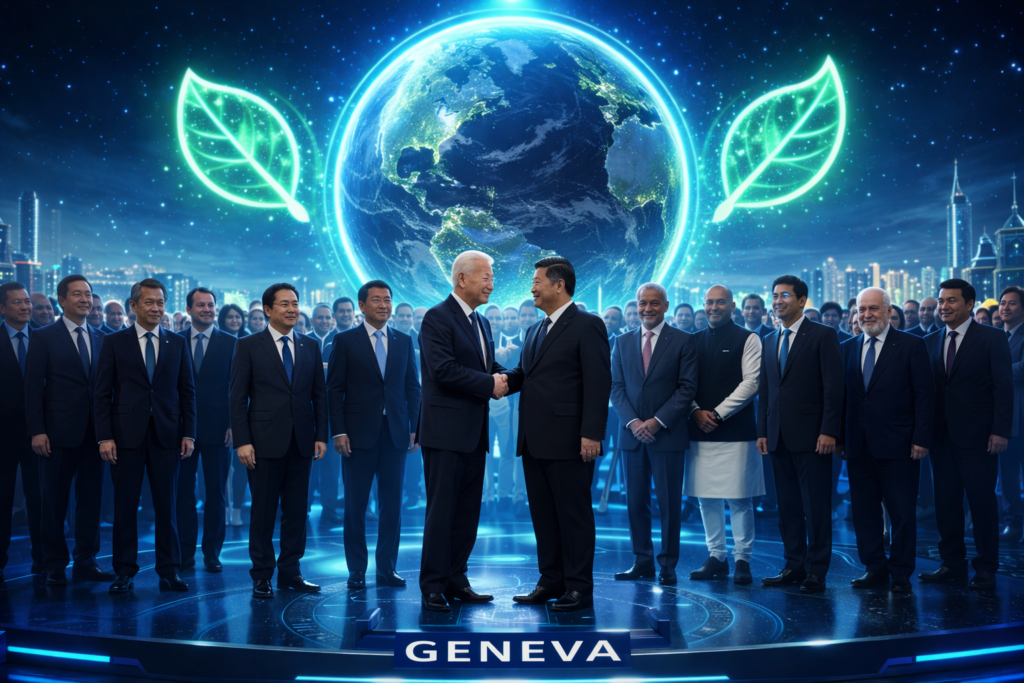
The journey to the Global Green Energy Accord 2026 was fueled by the extreme weather patterns of 2025. Governments finally realized that isolated efforts were insufficient. The “Geneva Summit” brought together not just politicians, but also the world’s leading scientists and tech titans.
Read our previous coverage on 7 Best AI Life Hacks 2026 to Save 20+ Hours Instantly
The core objective was simple: to create a legally binding framework that forces a transition to 100% renewable energy by 2040.
2. 7 Major Wins from the Global Green Energy Accord 2026
Win 1: The Universal Carbon Tax
For the first time in history, a flat global carbon tax has been agreed upon. This ensures that multi-national corporations cannot move production to “pollution havens.” Every ton of CO2 emitted now has a fixed price, which will fund green projects in Africa and Southeast Asia.
Win 2: Open-Source Green Tech Patent Sharing
In a surprising move, major powers including the USA, China, and the EU have agreed to open-source over 5,000 patents related to solid-state batteries and high-efficiency solar cells. This is a massive win for the Global Green Energy Accord 2026.
Win 3: The $10 Trillion “Green Transition Fund”
A massive fund has been established to help developing nations leapfrog the industrial age. This money will be used to build massive solar farms in deserts and wind corridors across the globe.
Win 4: Protection of 50% of World’s Oceans
The accord isn’t just about energy; it’s about the ecosystem. A historic 50% of international waters are now designated as “no-take” zones to allow marine life to recover and continue absorbing carbon.
Win 5: The Ban on New Internal Combustion Engines by 2030
The Global Green Energy Accord 2026 has set a firm deadline. No new petrol or diesel cars will be manufactured globally after 2030, accelerating the transition to Electric Vehicles (EVs) and Hydrogen transport.
Win 6: Decentralized Smart Grids
The agreement promotes the building of “Trans-Continental Grids.” Imagine solar power from the Sahara desert lighting up homes in Northern Europe. This interconnectedness will ensure energy security for all.
Win 7: Mandatory Climate Education
Starting in 2027, every school curriculum worldwide will include standardized climate science and sustainability training, ensuring the next generation is equipped to maintain these gains.
Official UN Press Release on Geneva Accord 2026
3. Economic Impact on Developing Nations

One of the most debated aspects of the Global Green Energy Accord 2026 was how it would affect the Global South. Fortunately, the “Win-Win” clause ensures that these nations receive technology first. India and Brazil are expected to become the new “Green Energy Superpowers” by 2030 due to their geographical advantages.
4. The Role of AI in Monitoring Compliance
How do we ensure nations don’t cheat? The accord introduces the “Sentinel AI System.” A constellation of satellites powered by Artificial Intelligence will monitor methane leaks and carbon emissions in real-time. This data will be public and immutable, stored on a global blockchain.
10 Best Apple Glass 2026 Features: The End of the Smartphone Era?
5. Geopolitical Shifts: The End of Oil Diplomacy?
The Global Green Energy Accord 2026 signals the end of the “Petrodollar” era. As the demand for oil plummets, traditional oil-exporting nations are rapidly pivoting to Hydrogen production and tourism. This shift is redefining alliances in the Middle East and beyond.
6. Challenges and Criticisms
No agreement is perfect. Some critics argue that the 2030 deadline for engines is too aggressive and might lead to economic instability in regions dependent on traditional manufacturing. Others worry about the “Deep-Sea Mining” required for battery minerals.
However, the consensus remains: the cost of inaction is far higher than the cost of this transition.
World Bank Analysis on the Costs of Global Energy Transition
7. Conclusion: A New Dawn for Earth
The Global Green Energy Accord 2026 is more than just a piece of paper; it is a promise to future generations. As we close this chapter of world news today, there is a palpable sense of hope. For the first time, humanity has chosen cooperation over competition to solve a global crisis.
The road ahead is long, but with the 7 major wins identified today, the journey to a greener, cleaner earth has officially begun.